Tuesday, March 19, 2013

Sunday birthday supper

We celebrated Carmen's birthday on the 17th with a prosecco toast, crostini with a variety of toppings (fresh ricotta, pesto, Tuscan beans, sauteed mushrooms), olives, and a big chunk of pecorino cheese, as starters.

For the main course, I made a big pot of stew, appropriate to the day.

I rendered a few slices of thick-cut pork belly (bacon, but uncured, which I get at the Korean supermarket), in my beautiful Magnalite® covered roaster.
  
I started with  3 lbs beef chuck, in the form of three semi-boneless chuck steaks, which were browned one-at-a-time in the casserole, cooled, boned, then cubed.  Most recipes would call for cubing the meat, then browning it well, which, though a sensible strategy for flavor and color, is tedious as hell.  So, I take a shortcut, and brown the whole steaks, then cut them up.  There's sufficient browning happening, as you can see in the photos, and it saves a huge amount of effort.


I set aside the meat.  Into the casserole I put carrots (1 lb, cut in chunks), onions (2 large, quartered), shallots (4), garlic (6 cloves), celery root (1 knob, cubed), and parsnips (2, cut in chunks) and sauteed them gently in the casserole.  After a few minutes, I added 2 Tbp tomato paste, and browned that a minute or two.  A couple bay leaves, a good teaspoon of dried thyme, and two sprigs of rosemary went in.   


The cooking liquid: this is the part where there is an immense variety of choices -- meat stock, wine, beer, veggie stock, water, or a combination of any of those can be used.  I chose beer: three 12-oz bottles of amber lager, in this instance, Yuengling. I would typically steer away from more bitter beers like IPAs. Stouts or porters would work, though the very assertive flavors of those kinds of beers might overpower the stew.

Regardless of  what liquid is used, you'll want it to come up to about 2/3 of the way to the top of the meat.  When finished cooking, you'll have plenty of sauce. 

 
The cubed beef was added back, and everything was brought to a simmer, the casserole covered, and then placed into a 325°F oven for 2.5 hrs, until the meat was fork-tender.  I let it sit until dinner time, then warmed it back up to serve.

(By the way, I nestled the bones cut off the steaks back into the pot while it stewed, then removed them prior to serving.  No reason to waste the flavor that bones bring.) 

I served the stew with buttered cavatelli.  Again, appropriately Irish.  ;-)


Sunday, February 10, 2013

Marmalade: winter sunshine

It's winter. Lots of citrus. Time for marmalade.

I used this recipe, from the National Center for Home Food Preservation at the University of Georgia, but substituting all oranges for the recipe's mixture of orange, grapefruit, and lemon.  I used seven tennis ball-sized sweet navel oranges.

Traditionally marmalade was made with sour, bitter Seville oranges, but they're nowhere to be found, and I don't miss the aggressive sharpness of such fruit in my marmalade.  I've done pink grapefruit marmalade, which is excellent, but today, grapefruit are very, very sweet, too. 

Fruit is boiled for about an hour to soften the fruit and remove bitterness from the peel, seeded, chopped, mixed with sugar and water, and boiled for about 20 minutes, until the mixture reaches 220°F. It's then put up in sterile jars, though I did this batch as a refrigerator jam, so no boiling water process after jarring.  Once cooled, the jars will go right into the fridge.  Got a bit over a quart of sweet orange marmalade.

Fruit is boiled for an hour to soften the peels, and remove a good deal of the bitterness.

Fruit is cut up, seeded (if necessary), and chopped fine.

 Finely chopped oranges. 


Thursday, February 7, 2013

BBC4: Breakfast, Lunch and Dinner

I found a great three-part series on YouTube from BBC4 in the UK.  Titled "Breakfast, Lunch and Dinner," and hosted by former "Fat Lady" Clarissa Dickson Wright

Fascinating stuff, an excellent mixture of good history and good food, and wonderfully entertaining.  

Breakfast

Lunch

Dinner 

You can find all three episodes in their entirety on YouTube


Wednesday, February 6, 2013

The vegan challenge

I spent a few days last week with several colleagues at a small trade show in San Francisco.  Two of my colleagues are vegan, which led me to start thinking about vegan food, and cooking it.

Vegans differ from vegetarians in that not only do they eschew meat, but they also avoid any product from animals, which includes dairy, eggs, and honey.  Silk and leather are on the list, too.  I wonder if they avoid carmine (aka cochineal), a common, natural red food coloring, derived from ground-up bugs. 

As you might imagine, I have my opinions about veganism and vegetarianism, but I'll save them for another post.  And don't get me started on the "I'm a vegetarian, but I eat fish" crowd.

I give these folks credit -- it cannot be easy, especially when dining out, and I've had the opportunity to witness how limited a selection there is when a vegan must dine out.   And though I don't see myself adopting that lifestyle, I would be happy -- eager, in fact -- to cook for them. 

Thinking more about this, I realized that vegan cooking is not unlike the old traditions (Italian, for sure, and probably similarly in other European cultures) of the food of Lent -- "la cucina della Quaresima."  These days we think of Lent as a time when we abstain from meat on Fridays.  Time was, not so long ago, that one abstained from meat for the entire 40 days of Lent, and the abstention went beyond just meat, but also included animal fats, so that dairy and eggs ("i latticini") were excluded, too.

6 weeks without meat, milk, cheese, eggs.  No wonder every special Easter dish -- cheese pie, meat pie, dyed eggs, eggy breads -- orgiastically celebrates breaking that fast. 

From a cook's perspective, cooking vegan food is a challenge.  Sort of like driving on the left side of the road. ("Stay on the left, stay on the left, stay on the left.")  Or playing one-handed piano pieces.  Or avoiding using the letter 'e' in any word in an essay.  You have to keep muttering to yourself: "no butter, no eggs, no milk, no butter, no eggs, no milk..."

Plenty in my repertoire is already vegan, or easily adaptable to vegan:
•  Simple pasta sauces made with olive oil -- tomato sauces, with an array of goodies added in -- olives, artichokes, capers (skip the anchovies, which I typically like to add, but can avoid), on dry pasta (have to avoid the fresh egg pastas).
•  Pasta sauces made with vegetable bases -- broccoli, cauliflower, asparagus.  I might miss the cheese to sprinkle over it, but I'll manage.  
•  Pesto, made with basil, nuts, and oil, but leave out the parmigiano.
•  Vegetables of every sort, sauteed in olive oil and garlic, accented with onion, or olives, or raisins, or lemon zest, or balsamic vinegar.
•  Stewed greens -- cabbage, chard, escarole -- with beans or potatoes, with white wine, or cider vinegar, or shredded apples.
•  Potatoes of all sorts, sure, but making mashed with olive oil perhaps. Well, there are always french fries, home fries (done with onion and bits of sweet pepper), or lyonnaise -- a potato casserole with alternating layers of thinly sliced potatoes and sauteed onions, covered in (veggie) stock, and baked with some toasted crumbs on top. 
•  Oven-roasted root vegetables, like rutabagas, turnips, sweet potatoes, parsnips.  Glorious when drizzled with garlic-scented olive oil, coarse salt, a good grind of black pepper, and maybe even a few drops of balsamic vinegar.
•  Salads, of course.
•  Pickled veggies, jazzed up with hot pepper.
•  Simple soups, made with water or veggie broth, lots of aromatics and bits of noodles or rice or greens. 
•  Bread!  As much as I love butter, I'm perfectly happy dipping it in olive oil.  Crostini, made from sourdough bread, schmeared with pesto, and topped with a really, really ripe tomato in September.  I can do that.
•  Mushrooms go a long way to adding much need savoriness to vegetables of any sort.  Heck, just this evening, I did a sauté of green beans and mushrooms.  Who needs meat?
•  Starches of all sorts -- rice, corn and polenta, oatmeal.  
•  Beans -- cannellini baked with onions, sage, and olive oil in the Tuscan fashion (one of the few ways that I enjoy beans), curried chick pea stews, rice and lentils, veggie lentil soup, black beans with garlic, cilantro, cumin in the Cuban style.

One of these days I'm going to prep a whole vegan dinner and serve it to my friends, and see if they notice. 

Ignore the chicken. 


Sunday, February 3, 2013

Souper Bowl

Lame pun.

Weather's been cold, wet, a bit snowy.  Need soup.  Decided I wanted to make a nice vegetable soup, but bolster it with something like meatballs. I love cabbage in soup, so decided to go in that direction.  And I wanted something more than just veggies, so opted for the meatballs, but thought about poaching them in stock so they're very tender in the soup.  What resulted is a kind of 'stuffed cabbage soup': many of the components that would go into stuffed cabbage, but less tomato-y and lacking the sweet/sour edge typical in its sauce.

I bought 5 lbs chicken bones at Giunta's yesterday, and immediately made a pot of stock when I got home.  Very nice.

For the meatballs:

1 lb ground beef
1 lb ground pork
2 slices soft white bread, cubed
1/4 cup milk
2 large eggs
3 cloves garlic, crushed
1 Tbp salt
1/2 Tbp black pepper
1/4 cup grated pecorino cheese
1/4 cup chopped parsley

Cube the bread, and pour the milk over.  Mash around until a soft paste is formed ("panade").  Add eggs, mix well.  Add meat to the panade, season with salt and pepper.  Add garlic, cheese, parsley.  Mix well.

Form into small meatballs.  (I always use a two-tablespoon ice cream scoop).
 
Bring 6 cups chicken stock to a simmer.  Add the meatballs, bring the stock back to a simmer, then let the meatballs simmer gently for about 5 minutes.  Turn the heat off, cover, and let stand 10 minutes.  The ambient heat will cook the meatballs through without toughening them.  Remove meatballs from the stock and set both the meatballs and stock aside.
 
Meatballs, after gentle poaching in chicken stock. 

For the soup:
2 large onions, diced
1 shallot, minced
6 cloves garlic, sliced
2 carrots, shredded
1 stalk celery, diced
1/4 cup olive oil
1 Tbp tomato paste
Salt and pepper to taste
1 head Savoy cabbage
1/2 cup chopped parsley

Film a large Dutch oven with the olive oil..  Add onions, shallot, garlic, carrots, celery, and saute gently until softened, about 8 minutes.  Salt and pepper to taste.  Add tomato paste, stirring throughout, and let it cook about 2 minutes.  Add shredded cabbage.  Toss well with other veggies.  Add about 1/2 cup of the reserved stock, cover, and let the cabbage wilt.  Uncover, stir well,  Season again, to taste.

All the veggies, after cabbage has been added with a bit of stock, then cooked until wilted.

Add reserved stock, bring to a simmer, and let simmer about 15-20 minutes, until the veggies are tender.  Again, taste the soup, especially if you've used unsalted, homemade stock (as I did), and check for seasoning.

Add meatballs back, add chopped parsley, bring to a simmer, and serve.  Or cover and refrigerate to warm up later (even better). 

The finished soup.  The tablespoon of tomato paste gives the soup a rich color, without overpowering the flavor.  You can see a couple of the meatballs bobbing up at the surface.


 A steaming bowlful, with a good sprinkling of grated pecorino. 

Tuesday, January 15, 2013

Roast beef means roast beef hash

The beauty of having a roast beef on Sunday is roast beef hash on Monday.  Especially with a few poached eggs perched on top and a good grind of black pepper.


Hash is easy and the BEST way to use up leftover roasted meat.

I started with a few small Yukon Gold potatoes, cubed them, then microwaved them with a bit of water 10 minutes until tender.

In a skillet, I sauteed one large yellow onion in 2 T bacon fat (yeah, bacon fat) for a few minutes until softened, then added the cooked potatoes.  I seasoned liberally with salt and pepper, and let the mixture cook a few minutes until gently browned.  I added a few chopped scallions, too, to add some color.

I cut up leftover roast beef (about 12 ounces, I'd guess) into small cubes, then minced it in the food processor to small pieces.  (Frankly, the roast, though tasty, was tough, and it needed to be broken down to avoid a chewy mess.)  Added the minced beef, and leftover roasted carrots and onions, which had been diced, to the skillet.  Also added about a cup of the leftover mushroom gravy.  Yowza!

The key to great hash is that it must be left undisturbed in the skillet until it is crisp and brown, then turned in sections to let the other side brown.  It's not a frittata, so does not have to be slid out of the pan and inverted to brown the other side.  (You CAN do that, but no need to.)  This is not haute cuisine

When nicely browned, spoon some into a shallow soup plate, top with a few poached eggs, give a good grind of black pepper, and enjoy!


Waring Pro MBB Series Stainless Steel Blender (Google Affiliate Ad)

Good news at the market

The roster of vendors at Reading Terminal Market continues to evolve. 

The newest, opening January 16, is Valley Shepherd Creamery.  They'll make several cheeses, including fresh mozzarella, right at the market.  Nice.

Good write-up in this morning's Inquirer

http://www.philly.com/philly/blogs/the-insider/More-gouda-news-out-of-Reading-Terminal-Market.html


Monday, December 24, 2012

Calzoniti -- special Christmas Eve treat

I know these confections being made only one day of the year, Christmas Eve.  And I know only one person who ever made them, my grandmother, Louise Cordivari. 

Calzoniti (diminutive of calzone) are quite simply, fried ravioli with a sweet, rather than savory, filling.  They are an Abruzzese specialty, and typical of that, contain a peculiar combination of nuts and fruits.  The colloquial pronunciation of calzoniti is something like “cah-joo-NEET.”  I've also seen them called "caociun" in the Abruzzese dialect, and "calzoncelli" in the Salerno dialect.  However you pronounce it, they’re quite delicious.

One difficulty with these treats is that the dough that Granny made, though very tender, did not stick well to itself.   Sealing the calzoniti after they’ve been filled could be difficult.  My cousin Tom could do an entire comedy routine on how our grandmother sounded when she made these every year: “They’re opening up!  What did I do wrong?  The filling’s too cold!  The filling isn’t cold enough!  The oil’s too hot.  The dough’s too tender!  We didn’t seal them properly!”   The problem with doing something (like making calzoniti) only once a year is that by the time you’re finished making them, and have figured out the tricks about doing them right, you’re done for the year.  And by the time the next year rolls around, you’ve forgotten all the tricks, and end up relearning them year after year, and making the same mistakes year after year.

In the interest of sanity and convenience, I ditched the homemade dough altogether, and substituted Chinese dumpling wrappers.  They work great.


 The filling is simple:

1/2 cup nuts (of any variety, really, though I typically use pecans or almonds; you can also use chestnuts -- buy the cooked, peeled ones at the Korean market when you're picking up the dumpling wrappers)
1/2 cup chocolate (I use milk chocolate, ground up with a few pulses in the food processor)
1/2 cup prune butter (which you can usually find in the baking aisle in your supermarket with the pie fillings; alternately, you can get fig butter at Trader Joe's, if you have one near you)
1/2 cup jam (I make my own, so always have apricot jam on hand; any type will work fine)
1/4 cup raisins (black or golden)

Mix well, and set aside.

Beat an egg with a tablespoon of water to use to seal the dumpling wrappers. Take a dumpling wrapper, put a teaspoon of filling in the middle, wet the edges with the egg wash, and fold the wrapper in half, pressing along the edge well to seal.  Set aside.  Continue until you've used up the wrappers.  Two cups of filling and a package of wrappers will give you about four dozen calzoniti.


It's not a bad idea to let the calzoniti sit for half an hour so that the wet seals dry.

Heat vegetable oil in a skillet or small saucepot.  Fry the calzoniti a few at a time until golden brown, turning to brown each side.  The dumpling wrappers brown QUICKLY -- in about 30 seconds -- so keep an eye on them.  Remove to absorbent paper towels, and let cool completely.


 Dust with powdered sugar, or a combination of powdered sugar, cocoa powder, and cinnamon just before serving. 


Monday, November 26, 2012

Homemade ricotta


Why make ricotta when it's so easy to purchase?  Why indeed?

One taste, and you'll understand -- the homemade stuff has a richness, smoothness, and character not found in commercially produced product.  And, to boot, it's pretty easy to do.

I'd seen it done a couple times in online videos, among them Melissa Clark (New York Times) and Mark Bittman (also New York Times).  Both are similar.

My recipe:

   1 gallon whole milk
   1 quart heavy cream
   1 quart buttermilk
   juice of two lemons
   2 tsp salt

I put all the stuff into an 8-quart stockpot, and brought to a boil, stirring occasionally to be sure there was nothing sticking/burning on the bottom.

As it came to a boil, the curds started forming, and I let it boil for several minutes.  The curds seemed VERY fine, finer than what I was seeing on the instructional videos, possibly the consequence that I added more cream (and thus more fat) than Bittman or Clark.

I ladled the curds and whey into a cheesecloth-lined colander and let it drain.  I was only able to fill the colander up about halfway.  The draining was VERY slow, again, probably the result of my very fine curds.  Coarser curds would have drained more quickly.  I ended up having to line another big strainer with a linen tea towel and drained the other half of the curds in that.  I covered both, and walked away for an hour to let them drain.  Upon returning, most of the liquid was gone, but the collected curds were very fine and very smooth -- and very moist.

I transferred all to a container, and popped it into the fridge.  A couple hours later, I checked on it, and noticed that it was still quite wet, even "soupy."  Not good.  I lined a strainer with a few layers of paper towel, and suspended it over a stainless bowl, dumped the soupy ricotta into it, covered it with plastic wrap, and put it back into the fridge overnight.


Next morning -- a dense, dry ball of ricotta, and about another half-cup of whey drained out below.  Perfect.

Where to use it?  Here, and here, and here, and here, and...


Hot pepper relish and ricotta -- a killer combo

I'm reposting my hot pepper relish recipe because I served it for the Orphan Thanksgiving dinner Saturday night. 


Instead of the typical cream cheese and cracker accompaniment, I served it with homemade ricotta cheese and crostini.  The smoothness and richness of the homemade ricotta against the sharpness and sweetness of the hot pepper relish, along with the crunch of the savory crostini was outstanding, and a huge hit with the guests. 

Sheaffer Prelude Fountain Pen - Fine Writing (Google Affiliate Ad)


Sunday, November 18, 2012

Thanksgiving planning and logistics

Getting my act together for the upcoming Thanksgiving meals.  Yes, meal-s.  I'm hosting dinner for the family on Thursday, then hosting my annual "Orphan Thanksgiving" on Saturday for the gang.  

There will be six of us for dinner Thursday -- hardly a huge crowd -- but a nice number to serve for a special, but nonetheless relaxing, family dinner.

Family dinner menu:

Cauliflower fritters
Finocchio
Olives

Roast turkey
Stuffing
Gravy
Buttermilk mashed potatoes
Sauteed Brussels sprouts with balsamic vinegar
Apple-nut-cranberry gelatin mold
Rosemary dinner rolls

Iced tea, wine, beer, soda, cocktails

Pumpkin and pecan pies with bourbon whipped cream
Ice cream
Coffee
Nuts and figs

Working on my logistics.  Ideally I'll prep as much as I can on Wednesday so that Thursday is less of a stroke-inducing rush.  Mom's doing the pies and the cranberries.  Aunt El is bringing the ice cream. 


I'll make my stuffing, and gravy base, boil and rice the potatoes, blanch the Brussels sprouts and the cauliflorets, chop up carrots, onion, and celery to put around the roasting bird, have some peeled garlic and sliced shallots prepped and ready, set the table, and get out the serving pieces.  

Thursday will be for cutting up and roasting the bird, baking the rolls, and making iced tea.  We've already nixed the sweet potatoes -- just way too much food.  


"Orphan Thanksgiving" will be a more casual affair, and with a crowd of 8 to 10, I'll likely be serving it as a buffet.  That way, it also allows me to set up a bar on the dining room table, and gives the gang plenty of time to relax, and munch in the living room.  They seem to like sitting and munching. 

Oh, and there will be a big-ass pitcher of sangria, too.  

I'll be roasting an extra turkey breast Thursday that I'll use for the hot Brown sandwiches Saturday.  

The "Orphan" menu:

Finocchio with olive oil/garlic/anchovy dip (a not so 'caldo' bagna cauda)
Deviled eggs (Chris)
Assorted cheeses and crackers
Another potluck hors d'oeuvres (Bob)

Hot Brown sandwiches
Sauteed Brussels sprouts (yes, same as Thursday)
Buttermilk mashed potatoes (ditto)
Cranberry sauce

Sangria, iced tea, wine, beer, soda

Dessert (Ben's bringing that; it's Mike's birthday)
Coffee
Ice cream
Nuts and figs

Hot Brown sandwiches, if you've never encountered them, are open face turkey sandwiches.  Sliced white-meat turkey is laid on lightly toasted bread, a couple strips of crisp bacon are draped over, a slice or two of tomato, then the whole napped with a rich cheese sauce, after which they're put under the broiler to brown.  The "Brown" name (capital "B") comes not from the color or the broiling, but from the fact that they originated at the Brown Hotel in Louisville, Kentucky.  They are remarkably good. 

Friday, November 16, 2012

Time to make the stock

Thanksgiving approaches, and one of the most important ingredients I must have is stock -- good, rich, homemade turkey stock.

It's the week before the big dinner.  I bought a couple turkey wings and a turkey neck at Giunta's in Reading Terminal Market.  

I filmed an 8-qt stockpot with some peanut oil, added the turkey parts, a couple carrtos, a rib of celery, and a halved, unpeeled onion.  Roasted the meat and veggies at 350°F for about an hour, until the meat was browned.  This is my shortcut -- I just roast the meat in the same pot in which I'm going to make the stock.  All the browned bits and meat juices are captured, and only one thing to clean up. 

You absolutely can make the stock with unbrowned (raw) meat.  The result will be delicious, too, though much lighter in color than this version.  I'm fond of more darkly colored and flavored stocks, even poultry stocks, which are more typically done with raw, rather than roasted, meat.  The vegetables roasted along with the meat add a lot of flavor and color to the stock.  Beef stock is almost always made with roasted beef and beef bones.

Covered the roasted bits with about 10 cups of water, added a couple bay leaves, a generous bunch of parsley, stems and leaves, a teaspoon of dried thyme, and a few garlic cloves, unpeeled and cut in half.  Brought the pot to a boil, lowered the heat to a bare simmer, then let it simmer for about 2 hours, partly covered.  Turned off the heat, and let it sit several hours to cool.  Strained it into a container, and refrigerated it. 

I do NOT season the stock at this point, preferring to season the dish that I'm going to use it in -- the stuffing, the gravy, or as liquid to baste the turkey.  

This is the best, richest, homemade stock ever. 

 Roasted turkey wings and neck, with onion, carrot, celery,
covered with water, and ready to simmer.
 

Added a couple bay leaves, garlic cloves, parsley, and a teaspoon of dried thyme.
Simmered two hours, then let sit until cooled. 
Strained, and refrigerated.

Sunday, November 4, 2012

A bowl of sun on a gray day -- sausage lentil soup


The hurricane here wasn't so bad, but the weather has been gray, gray, gray.  I needed a bowl of something warm and comforting, and made one of my favorites -- sausage lentil soup.


Mom made lentil soup frequently, but always used a ham broth -- almost like a split pea soup.  An excellent way to do it, but I've always preferred this style, which I've seen in Greek diners (do you notice a trend here??).  

There's much variation that can be made -- you could double the tomato, and reduce the amount of stock, you could add some tomato paste while the veggies are sauteing to increase the intensity and color of the tomato, you could omit the tomato altogether, and just go with stock.  You could make it completely vegetarian by using veggie sausage (I don't' recommend it, but it does exist), or nothing at all, and just eliminate it.  Herbs and spices can be changed up -- add some smoked paprika, or a couple chopped sage leaves, or one favorite of mine -- add chopped fennel along with the onion, celery, and carrot. 

1 lb Italian sausage, removed from casings and crumbled
1/4 cup olive oil
3 small onions, chopped
2 ribs celery, chopped
2 carrots, chopped
6 garlic cloves, minced
2 cups lentils, washed and picked over
1 28-oz can whole or crushed tomatoes
6 cups chicken stock
2 bay leaves
1 tsp dry thyme, or several sprigs fresh thyme
Salt and pepper

Brown the sausage in a Dutch oven, then remove and set aside.  Add oil to the pot.   

 
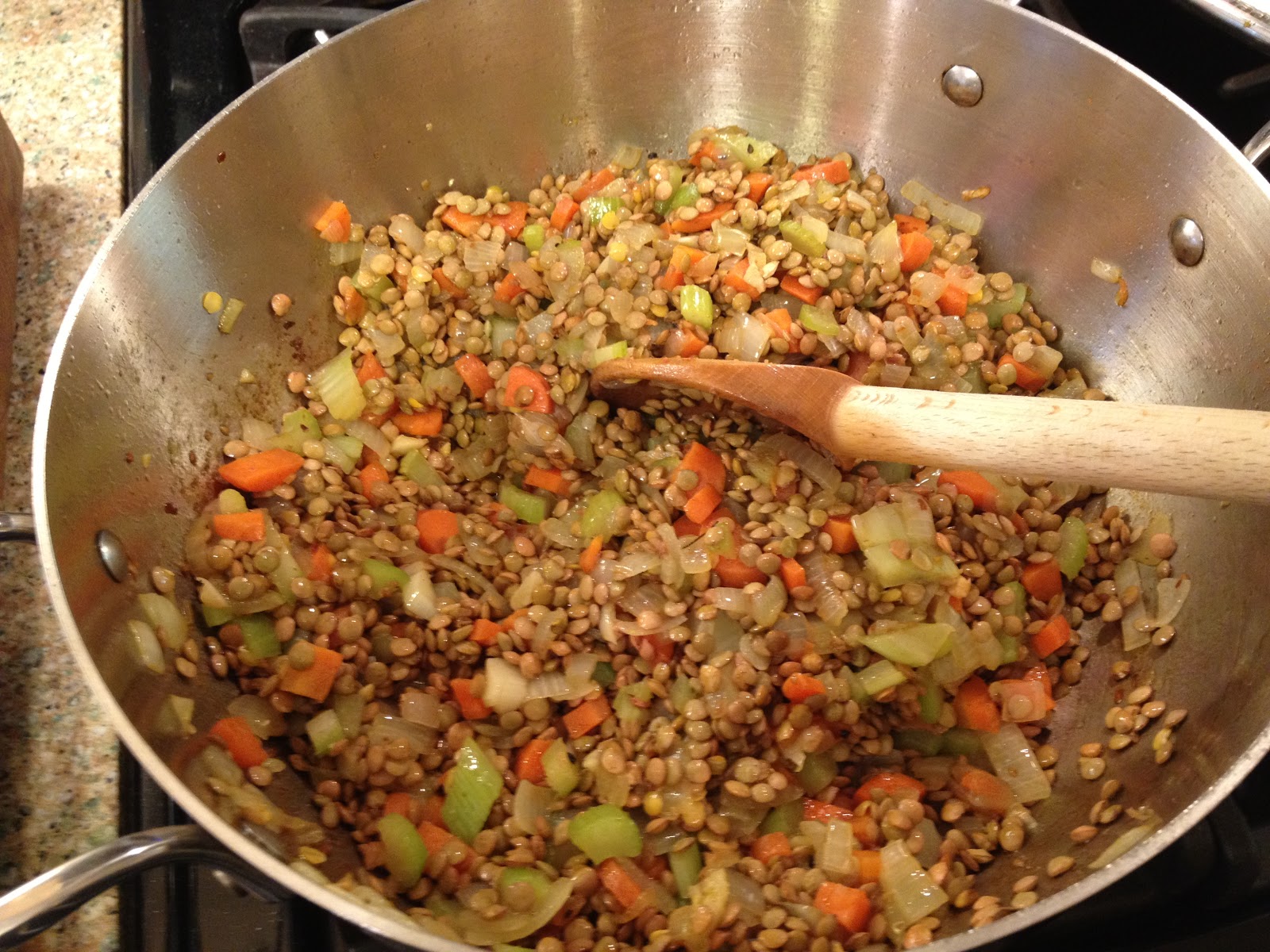
Add onions, celery, carrots, garlic, and sauté over moderate heat until softened.   

 
Add lentils, tomatoes, stock, bay leaves, thyme, and add back the cooked sausage.  


Bring to a simmer, cover, and let simmer over moderate heat for about 45 minutes, or until the lentils are tender.  

Serve with grated parmigiano or pecorino cheese.  


As with any soup of this kind, it's much better the next day!

Monday, October 29, 2012

Pre-Sandy Sunday Supper

I posted yesterday's pre-Sandy Sunday supper on Facebook, and got a few requests for recipes, so here we go.

The menu was penne with golden cauliflower, roasted chicken with shallots and carrots, and Greek-style green beans with tomato.

Penne with cauliflower

I bought a huge golden cauliflower from a farm stand in Lancaster County last weekend -- just a beautiful saffron-colored head.  You certainly don't need the golden variety specifically -- plain white cauliflower will do just fine.  Or green.  Or purple. 

1/4 c olive oil
2 medium onions, sliced
4 cloves garlic, chopped
1/2 red bell pepper, sliced thinly
2 anchovy fillets (optional, but it adds great flavor)
1 head of cauliflower, washed, and broken into florets
1/2 cup chopped olives (of your choosing -- Spanish olives, Sicilian oil-cured, Kalamata -- they all work fine)
2 Tbp capers
1/2 cup stock or water
Salt and pepper
1/2 tsp thyme
1/2 cup chopped parsley

In a large Dutch oven, warm the olive oil.  Add the garlic, and saute until just starting to brown.  Add onions, anchovies, and bell pepper, stirring gently until softened and slightly colored.  Add florets and stir well to coat all with the oil.  Add stock or water, turn heat down, cover, and let steam until the florets are tender, about 10 minutes.  Add olives and capers.  Taste for seasoning, and adjust with salt and pepper as needed.  Add thyme.  Mix well, and bring to a simmer.  Turn off heat.  Add parsley. 

Toss with 1 lb cooked penne pasta, reserving some of the pasta cooking water.  Add cooking water as needed if the mixture is too dry.  Drizzle with additional olive oil and serve immediately.  Pass grated pecorino or parmigiano cheese and hot pepper flakes at the table. 


Greek-style green beans with tomato sauce

A very simple preparation, and reminiscent of the tender, tomato-y beans you get in Greek diners.  First I make a simple marinara sauce.  (I would halve that posted sauce recipe for this one, or make the full recipe, and use just half for the beans.)  I blanch the beans in salted water until tender (about 6-7 minutes), and drain them.  I then combine the marinara sauce with the cooked beans, and bring it up to a simmer, cover it, and put it on the lowest heat, and let it simmer gently for about 15 minutes, until the beans are very, very tender.  If you're one who likes crisp green beans, this is not the recipe for you!

Be sure to sop up the tomato sauce with lots of good bread.  "Zuppa' nu pan!" [Neapolitan dialect -- soak the bread!]


Roasted chicken with shallots

Not much to tell here -- a 4 1/2-lb chicken, seasoned and dusted with herbs from the garden*, in a well-oiled roasting pan surrounded by carrots, celery, and shallots.  Roasted for about an hour at 375°F.  About 20 minutes in, I added a bit of stock to the pan to maintain moisture. 

Out of the oven, let it rest about 20 minutes, cut it up, and arranged the pieces on a serving platter with the roasted veggies.  I drizzled all with the pan juices. 

The leftover carcass will make a nice pot of stock. 

*In the last few weeks, I've harvested all my herbs, and dried them.  I have herbs for the whole of the fall and winter -- thyme, rosemary, oregano, marjoram, sage.  


Monday, October 1, 2012

Chicken and waffles

Invited Dewey to Sunday brunch.  I'd originally planned to usher in the fall season with pumpkin waffles, but at last minute, decided to go a different direction -- chicken and waffles.

I'll admit I've never eaten chicken and waffles -- fried chicken on top of crisp waffles, and drizzled with maple syrup or other types of (typically sweet) condiments. 

What the heck.

I have a great basic buttermilk waffle recipe from Saveur magazine.  I doubled that recipe for about 8 waffles total.  I also did NOT separate the eggs -- it's just not necessary for a waffle. 

2 cup all-purpose flour
2 tbsp. sugar
2 tsp. baking powder
2 tsp. baking soda
1 tsp. salt
6 eggs
2 cup buttermilk
4 tbsp. butter, melted and cooled

1. Combine flour, sugar, baking powder, baking soda, and salt together into a large mixing bowl.

2. Beat eggs in a mixing bowl and add buttermilk and butter. Add to flour mixture, stirring until just combined.

3. Spread batter over three-quarters of the surface of a hot, lightly greased waffle iron, close lid, and cook until brown and crisp, about 5 minutes.

On to the chicken.  The idea of a piece of fried chicken, bones and all, on top of a waffle seemed silly.  Why not a boneless breast or thigh??  My preference is for dark meat, so that's what I used.  I soaked 8 boneless, skinless chicken thighs in 2 cups buttermilk for 2 hours at room temperature.  Before you react to the room-temperature soaking, keep in mind that the chicken and the buttermilk were at 40°F when combined, and were cooked immediately after soaking.  Bringing the meat to room temperature before frying assists uniform cooking.

I drained the meat, seasoned it well with "house seasoning" (salt, pepper, garlic powder), then sprinkled a mixture of herbs and seasonings liberally on both sides.  My seasoning mixture was homemade (garlic powder, onion powder, black pepper, paprika, cayenne, thyme, rosemary -- but no salt in this mixture), but you can certainly use any good commercially available seasoned salt product.  The meat was then dumped into a bowl of all-purpose flour and tossed to coat well.  I let it sit for 10 minutes, then tossed again to assure complete coating.  Some folks double-dip their fried chicken -- flour, then buttermilk, then flour again -- but I find that doing that creates a very thick, unappetizing coating.  Too much "Colonel," not enough chicken.

The coated thighs were fried in about an inch of corn oil at 350°F, about 5 or 6 minutes per side, until brown and crisp, then kept in a 200°F oven until ready to serve.

Pile a few strips of bacon on top of a hot, crisp waffle, top with chicken, then drizzle liberally with maple syrup or homemade jam.  I also served a plum-apple compote alongside -- an excellent alternative to maple syrup. 

 Crisp buttermilk waffle, bacon, fried chicken, just before the syrup gets drizzled all over.

Tuesday, September 18, 2012

Onion soup gratinée

I wanted a quick dinner last night, and had a container of chicken stock in the freezer I wanted to use up.  French onion soup.

I've posted on this before, so no need to go into fine detail, but I do want to emphasize that this soup does NOT require a big investment in time, provided your pantry is well-stocked.

Variant here is that I used chicken stock.  I prefer a rich beef stock for onion soup, but didn't have any on hand, and chicken stock is fine. The stock I had was not particularly rich, having been made of scraps from roasted chicken breasts, so I needed to jazz up the soup a bit.

As the pot of onions was nearing its ideal caramelized state, I poured in about 1/4 cup sweet red vermouth.  Dry white vermouth would've worked, too, but the sweet red has an almost sherry-like flavor, which enhances the flavor of onion soup.  I then added the stock, and salted liberally, as the stock had not been previously salted.  FWIW, Aunt Millie used to say, "Kissing a man without a mustache is like eating soup without salt." 

I also added a few dashes of Worcestershire sauce, and a good pinch of Ajinomoto (a.k.a., monosodium glutamate).  Keep your panties on, folks, but it's a useful shortcut to add savor to food (like a wan stock).  And FYI, MSG comes from fermented soybeans.  Not surprisingly, so does Worcestershire sauce. 

I toasted up some excellent Italian bread from Metropolitan Bakery, and arranged the crostini on top of the soup, then covered the top with about 8 oz shredded Gruyere cheese.  Into a 425°F oven for 10 minutes, then under the broiler for about 3 minutes, until the cheese was melted and browned. 

Served a green salad with walnut-oil dressing on the side.  Awesome weeknight treat. 


Monday, September 10, 2012

Facebook fig jam, chapter two

I managed to post all this on Facebook -- appropriate, as that's how it all started -- but didn't put it directly into the blog.  That's now remedied. 

August 26, 2012 -- more figs from my high school friend Lisa F., who has a huge backyard fig tree, with more fruit than she can manage.  I stopped by and picked up about 6 pounds of ripe figs. 

As I did last year, I made a nice batch of fig jam -- this year, twelve 8-oz jars.  Lisa got three of them in return for the figs.

I always follow the recipes and directions of the National Center for Home Food Preservation at the University of Georgia.  

  • 2 quarts chopped fresh figs (about 5 pounds)
  • ¾ cup water
  • 6 cups sugar
  • ¼ cup lemon juice
Just look at the colors of those figs -- pink and purple and green and white...


The two jars you don't see there were unintended bounty.  I figured I'd get 10 jars, but in fact got 12, so had to quickly clean a couple more, and fill them.  Instead of processing them, I just popped them into the fridge.  They lasted about 3 days -- wiped out by many fig-jam lovers. 


Few things as satisfying as the sound of a big pot of bubbling jam....


Saturday, September 8, 2012

More summertime specialties -- peach jam and cucumber pickle

A quart of peach jam, and cucumber pickle (with red onion, scallion, and jalapeno).

The quart of jam was from 6 large peaches, peeled and chopped, with 3 cups of sugar, juice of a lemon, and a pinch of salt.  Cooked over high heat, with frequent stirring, until it reached 220°F with an immersion thermometer. 

Two 16-oz jars of peach jam, right out of the boiling water process.  


Six Kirby cukes peeled and sliced, with red onion, scallion, and jalapeno. 
Salt (about a tablespoon), sugar (four tablespoons), and cider vinegar (about a half a cup).
Mix well, then refrigerate for a few hours. 

Wednesday, August 29, 2012

"Pure and unrefined"

An article in today's New York Times hit a nerve, a chemist's nerve, in particular.

The article relates the delights of sea salt from the west coast of France.  Lovely stuff, for sure, but the understanding of what constitutes "purity" in the author's mind is peculiar.
Every grain, every crystal, is cultivated naturally, harvested by hand and marketed pure and unrefined.
So, if it's unrefined, it cannot be 'pure' salt at all.  The fact that it's unrefined means it's contaminated (and I don't mean that in a bad way) with other compounds.  Good contaminants, tasty contaminants, beneficial contaminants, mind you, but contaminants nonetheless.


 Author Elaine Sciolino then goes on to describe their process for harvesting gray salt:
Every other morning, when the weather is right, they harvest gros sel marin gris, or gray coarse sea salt, a moist and coarse salt that collects on the lining of the clay ponds, gray from the nutrients that sit in the clay.
The combination of a hot sun and a soft dry wind is needed to cause the perfect level of evaporation in the shallow, rectangular artificial clay ponds whose water level they control with a system of pipes leading to the sea. 
Collecting salt water using sea water piped in from the ocean into man-made clay ponds doesn't exactly scream "cultivated naturally."  In fact, it's quite technological in nature.  Picking a piece of fruit from a tree might be "natural."  Setting up a clever system for getting salt out of sea water isn't "natural" in any sense of the word. 

We also find out from the same paragraph that the "nutrients" in the salt that make it gray come from the clay ponds, the man-made clay ponds.  So, the contaminants in this "pure," "natural" salt come from letting sea water extract other salts from the clay in the the man-made clay ponds.  The so-called nutrients aren't even in the sea water to begin with, but in fact are added, albeit passively, to the water.  Natural.  Uh-huh.  

It's this kind of sloppiness in thinking that really pisses me off, and I expect more from a good reporter for a good newspaper.  This is a topic of interest to me because it sits at the intersection of food and chemistry, and it demonstrates profound ignorance on the chemistry side. 

Go head, mention "chemical-free" laundry detergent.  I dare you.