Monday, February 3, 2014

Sausage gravy on biscuits


It's a gray, cold, snowy day, and I needed a reminder that Sunday brunch on the patio in the backyard isn't too far away.

Sausage gravy with homemade biscuits. I've done this recipe before, but add this variation:  if you're so inclined, or if you don't have sausage on hand, this works equally well with any kind of ground meat -- beef, turkey, pork.  I would be sure to saute half an onion or a shallot, and maybe add a crushed garlic clove before browning the meat, to add extra flavor to unseasoned ground meat (unlike sausage, which is fully seasoned, and often flavored, ground pork). I also really like adding Worcestershire and Tabasco to jazz up the flavor. 


And after you've finished the sausage gravy, you can always slather a biscuit with sweet butter and homemade peach jam.  Yes, you can.


The recipe I've been using for biscuits is from the New York Times (Melissa Clark).  It's a very good all-purpose recipe, though written in an annoying style, as the NYTimes seems convinced of late, that all its readers are cooking with metric measurements.  Odd.

And though the recipe calls for part cake flour (to approximate the soft flours used in 'classic' Southern biscuit recipes), I typically use just all-purpose flour, and it works just fine.  

I don't use a biscuit cutter.  After rolling out the dough, I cut with a knife into triangles.  No fuss, no bother.  

Flaky Buttermilk Biscuits (source: The New York Times)
Yield 10 to 12 biscuits

Time 30 minutes
    230 grams (about 2 cups) all-purpose flour
    50 grams (about 1/2 cup) cake flour
    15 grams (about 1 tablespoon) baking powder
    8 grams (about 2 teaspoons) sugar
    6 grams (about 1 1/4 teaspoon) fine sea salt
    9 tablespoons unsalted butter, chilled and cubed
    1 cup buttermilk, chilled.

Method
    1. Heat the oven to 450 degrees. Line a rimmed baking sheet with parchment.
    2. In a bowl, whisk together flours, baking powder, sugar and salt. Using a pastry cutter or fork, quickly cut in 8 tablespoons butter until it forms pea-size crumbs and is uniformly mixed it (for flaky biscuits you want the butter to remain cold). Make a well in the center of the flour mixture and pour in buttermilk. Stir together until it just forms a moist, slightly tacky dough.
    3. Turn dough out onto a lightly floured surface. Knead 2 or 3 times, then pat out into a 3/4-inch-thick round. Using a 2-inch round cutter, cut the biscuits. Twisting the cutter prevents proper rising; to prevent sticking, dip the cutter lightly in flour between biscuits. Do not re-roll the scraps, but pat them together and cut into rounds. Transfer biscuits to the baking sheet.
    4. Melt remaining 1 tablespoon butter. Brush butter lightly over the tops of hot biscuits. Bake until puffed and golden, about 15 minutes. Cool 5 minutes before serving.




Fried stuffed peppers

This is one of those dishes from every Italian mother's repertory -- long, sweet peppers (sometimes called "cubanelle" in grocery stores), that have been stuffed with a savory bread mixture, then fried until tender.


It's filling, frugal, vegetarian, and delicious. Makes a great side dish to a roast, or chicken cutlets, or a main course for a Lenten Friday. 

For the savory bread stuffing, to fill 6 - 8 peppers, depending on size:

6 slices good-quality white sandwich bread (like Pepperidge Farm or Arnold's), crusts and all, pulsed into crumbs in a food processor
Enough milk to moisten the crumbs, maybe a scant half cup
A clove or two garlic, crushed
Salt and pepper
A couple tablespoons chopped parsley
A couple tablespoons capers, drained and chopped
A dozen olives, chopped (any sort will do -- from green olives with pimentos from a jar, to Kalamata, to oil-cured Sicilian)
1/4 cup grated pecorino
A good drizzle of olive oil
An anchovy filet or two, if desired.

Moisten the crumbs with the milk.  You want to have a soft mass, but not a soupy one.  Add the other ingredients as you have and as you like.  You're aiming for a savory mixture, and very accurate measurements are not too critical.  I like to add an anchovy filet for savor, but feel free to leave it out if you don't like it. If you want to taste the mixture prior to filling the peppers, take a tablespoon of it, place it in a ramekin, and pop it into the microwave for a few seconds to cook.  Taste for seasoning.  Adjust as necessary.

Prep the peppers:  cut the tops off, and remove the seed pod.  Spoon a couple tablespoons of the stuffing mixture into each pepper, being very careful not to overstuff.  The stuffing will expand as it cooks, as you can plainly see in the photo below.

Heat a skillet over a medium burner, film with olive oil, and add the peppers.  I find the easiest way to cook these is in a 350°F oven, for about 15-20 minutes, turning every so often so they cook evenly.  Alternately, you can continue to cook them on the stovetop.

You will likely notice that as the peppers cook, the skins will darken and begin to peel.  No need to worry, but if you're so inclined, you can peel them off before serving -- they come off very easily. 

Serve hot, or at room temperature. 

By the way, that skillet in the photo is my 12-inch DeBuyer steel skillet.  Steel (not stainless, mind you), get very 'ugly' very quickly as they are used and seasoned, but they conduct heat nicely, and can be used on the stovetop or in the oven.  A nice investment, and compared to stainless pans (like All-Clad), much less expensive. 


Pasta alla carbonara, sort of.

Not quite authentic carbonara, but close.  I used plain old bacon, not guanciale or pancetta, and onion in this. 

It's still very good.

1 lb pasta -- I used gemelli, "twins," 2-in long helices  (or other short pasta of your liking)
1/2 lb bacon, chopped into small pieces
1 large yellow onion
2 cloves garlic, crushed
2 egg yolks
Black pepper
Chopped parsley (optional)
Grated cheese -- pecorino or parmigiano

Saute the bacon in a skillet -- you can add a bit of olive oil to get things started -- until it is browned, but not fully crisp.  Add onions and garlic, and cook until the onions are softened. 

While the bacon and onions are sauteing, boil the gemelli in ample salted water, and drain, reserving a cup or so of the cooking liquid. 

Tip the cooked gemelli into a serving bowl, add the sauteed bacon/onion/garlic mixture to it, mixing well.  Add two egg yolks, and toss well, to let the yolk coat the pasta and create a creamy sauce.  Add pasta cooking liquid as necessary or desired to loosen the mixture.  Grind a generous amount of black pepper over all, and give one final toss. 

Garnish with chopped parsley, if desired.  Pass cheese at the table.  


Thursday, January 2, 2014

Slow-roasted perfection


Roasted pork shoulder, studded liberally with garlic and herbs, then roasted in an open pan at 325°F for about 4 hours. 

Tender, juicy meat, basted continually by the layer of fat, and an an irresistibly crisp skin, which you can peel off, break up, and snack on while finishing up your meal preparations. 

This was an 11-lb, bone-in, whole shoulder roast. 

I made some stock in the morning, and used a few tablespoons of the rendered fat to make a silky gravy. 


Seven-word wisdom


Eat everything.  It's not medicine.  Nor poison.

My entry in a long-ago New York Times contest for a seven-word 'haiku,' mimicking Michael Pollan's words of wisdom: Eat food. Not too much. Mostly plants.   [For you sticklers out there, yes, I understand that it's not a haiku, as typically defined, but more an aphorism, a distilled, concise statement of principle.]

I didn't win, but I still like my entry. 

It's a sentiment echoed recently by chef/writer Michael Ruhlman in recent blog entries, which led me to dig out that 'haiku' I entered into the contest. 


Wednesday, December 25, 2013

Gurgle, gurgle, gurgle...


Monday, December 23, 2013

Good news at the Italian Market

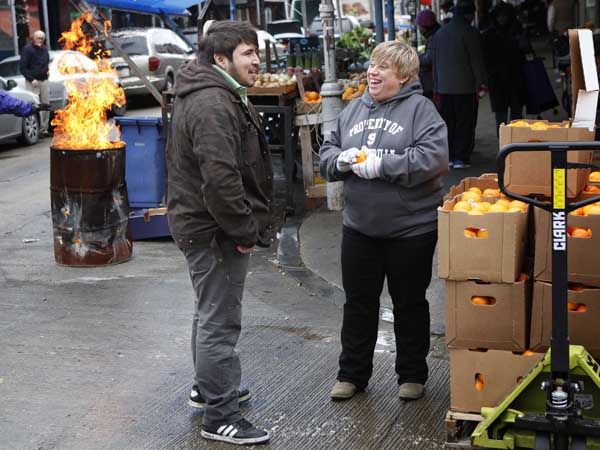
Good news for the Italian Market, on South 9th Street, in Philadelphia.  

http://www.philly.com/philly/business/20131223_Long-awaited_change_coming_to_Italian_Market.html?&c=n

Michele Gambino (right), business manager, United Merchants of the South 9th Business Association, talks with merchant Jonathan Rivera (left) of Tortilleria San Roman. The Italian Market is now more the Italian-Mexican-Vietnamese Market. December 17,  2013.( MICHAEL S. WIRTZ / Staff Photographer )

Saturday, December 14, 2013

Cinnamon-raisin swirl bread

Wonderfully easy.

1 loaf frozen white bread dough, defrosted
3-4 Tbp cinnamon-sugar butter (see below)
1/4 cup raisins

Defrost the loaf of frozen dough, and roll out on a floured surface to about 15" x 6".  Smear the surface with the cinnamon-sugar butter, sprinkle the raisins on top, and then roll it up from the short end into a loaf.

Drop into a well-greased loaf pan, and let rise for a couple hours in a warm spot.  (I heat my oven for a few minutes, then turn it off.  That gives a nice, toasty environment for proofing the bread.)

When well risen, bake in a preheated 350°F oven for about 30 minutes, until golden on top.  Remove from loaf pan, and cool completely on a wire rack.


Cinnamon-sugar butter

1 stick butter (4 oz, 1/4 lb), fully softened, but not melted
1/2 cup light brown sugar
3 tsp ground cinnamon
Pinch salt (if you're using unsalted butter)

Combine ingredients into a paste.  Spread over hot toast or use in the cinnamon-raisin swirl bread above.  


Wednesday, November 27, 2013

Now THAT'S good stock

I made a big pot of turkey stock the other day, to have on hand for making my Thanksgiving stuffing and gravy.

I got some turkey necks and wings at Reading Terminal Market, and roasted them along with carrots, onions, and celery for about 2 hours at 325°F (along with a few turkey thighs -- more on that later).  I put the roasted meat and veggies into a big 12-qt stockpot, and added a roasted chicken carcass that I had in the fridge from dinner the other night, and a bone from a recent pork shoulder roast that I had saved and popped into the freezer.

Covered everything with water, brought the pot to a boil, lowered it to a simmer, and let the stock simmer gently for about 3 hours.

Discarded all the bones (not much in the way of meat to retain), and let the stock cool fully.


Now THAT'S good stock -- jiggly when cold, full of gelatin, which adds considerably heft and substance to a stock.  


Sunday, November 24, 2013

Eggs in purgatory, or shakshuka

Interesting dish -- seems there are versions of this throughout the Mediterranean -- Italy, Israel, North Africa, and I'd imagine the Spanish, Greeks, and French do it, too. 

Italians call this "eggs in purgatory," though why is unclear.  This dish is pure heaven, especially if you make the tomato sauce with fresh tomatoes in the height of summer. 

First, a simple, spicy tomato sauce:

1/4 cup olive oil
1 small onion, chopped
3 cloves of garlic, chopped
1/2 tsp red pepper flakes

1 28-oz can whole plum tomatoes, crushed lightly with your hands
Salt & pepper
1 tsp thyme

In a skillet, warm the olive oil.  Add onion and garlic, and saute a few minutes until the onion is translucent and beginning to color.  Season with salt and pepper  Add the hot pepper flakes. 

Add the tomatoes, bring to a simmer, reduce heat, add thyme, and let simmer uncovered for about 20 minutes. 

Crack a few eggs into the sauce while it is simmering over a low flame, and let them cook gently for about 4 minutes.  You're essentially poaching eggs in a tomato sauce rather than water.

Serve immediately in wide soup plates, with toasted French or sourdough bread that has been rubbed with a raw garlic clove, and drizzled with olive oil.

 Eggs poaching in spicy tomato sauce.


You could clearly do this with other sauces -- a vegetable ragout like ratatouille would be great, or just a simple stew of yellow summer squash and fresh tomatoes.  Adding olives or capers to the tomato sauce would be an excellent choice, too.  If you had some grated pecorino or parmigiano, please do sprinkle some on top. 


Mushroom barley soup

On a frigid night like tonite, the allure of a bowl of hot soup cannot be underestimated.  

I love making soup -- simmering the stock, and getting it rich and flavorful, sauteing veggies for the base of the soup, adding those little 'hidden' ingredients that you really can't 'taste,' but improve the character of the soup so drastically, like a dollop of tomato paste, a glug of sherry or port, a couple teaspoons of Worcestershire sauce, a tiny bit of cream.  

There are few soups that aren't better the day after they're made, and this is certainly one of them.  I suspect that the reason has much to do with the starch that's added to the soup -- barley, rice, noodles.  As the soup sits, starch leaches from the barley into the stock, and consequently thickens it, gives it body, which adds a pleasant mouthfeel to the soup, and improves overall flavor. 

3/4 c pearl barley, cooked in copious amounts of salted water until tender, about 45 minutes. 

1 lb button mushrooms, sliced
1/2 lb shiitake mushrooms, stems removed, sliced
2 Tbp each, fresh sage and parsley, chopped

In a skillet, melt 4 Tbp butter in 2 Tbp olive oil, and sauté one finely chopped shallot about 2 minutes.  Add the sliced mushrooms and sauté until tender and lightly browned.  Season with salt and pepper.  Add chopped parsley and sage.    Set aside.

1 onion, chopped
1 large carrot, grated/shredded
4 cloves garlic, crushed
1 Tbp tomato paste 
6 cups stock (beef or chicken)

In a Dutch oven, sauté onion, carrot, garlic until softened, about 5 minutes.  Add tomato paste, and sauté a minute or two more.  Add stock.  Add the sautéed mushrooms and barley.  Bring to a simmer. 

Best served the next day.  

Quick cassoulet – bean-and-sausage casserole

Julia Child does cassoulet in her Mastering the Art of French Cooking, and it is a triumph of exhausting preparation and long cooking.  The recipe goes on for four pages, and includes pork loin, sausage, beans, bacon, and optionally duck or goose confit. 

Probably not the best choice for dinner on a Tuesday evening.

My version does require a tiny bit of forethought – soaking the beans, but not much beyond that.  

1 lb dry white beans (like Great Northern, navy, or cannellini)
About 8 – 10 cups water, to cover
2 tsp baking soda

8 cups fresh water (not the bean soaking liquid)
1 onion
1 rib celery
A couple cloves of garlic
Thyme
Sage
Bay leaf
Salt & pepper
Olive oil

2 cups fresh bread crumbs
2 Tbp olive oil
1 clove garlic, crushed
Dry herbs – thyme, sage, marjoram

Cover 1 lb white beans  with about 8 cups of cool water.  Add baking soda (which aids the cooking later).  Cover, and let sit in a cool place overnight. 

Drain the beans and discard the soaking water, and dump the beans into a Dutch oven.  Cover with another 8 cups of water, and toss in a peeled, halved onion, a stalk of celery, a couple cloves of peeled garlic, a bay leaf, and a few sprigs of thyme (or a teaspoon dried thyme), and a sprig of sage (or a bit of dried sage), and good teaspoon of salt and a good grind of black pepper.  Drizzle a glug of olive oil over all.  


 Bring to a boil, reduce the heat, and let simmer gently partly covered until the beans are tender, about 45 minutes to 1 hour.  Having been soaked earlier in water containing baking soda, the beans will cook fairly quickly, and should be fully tender within an hour’s simmering.  The water level should be at the top of the beans or just below.  Test the beans carefully for doneness, and test for seasoning, too.  Remove the veggies and herb sprigs if you’d like. 

While the beans are cooking, roast a pound of Italian sausage in the oven until browned. 

Nestle the sausage links into the beans.

Film a heated skillet with the olive oil, add the crushed garlic, and cook very briefly until fragrant.  Add the fresh bread crumbs and the herbs, and saute briefly until the crumbs are very lightly toasted (they’ll have the opportunity to brown more later). 

Sprinkle toasted crumbs atop the beans and sausage, and pop the Dutch oven, uncovered, into a 375°F oven for about 15 minutes, until the casserole is bubbly, and the crumbs nicely browned.  


Optional additions: you can pretty much add whatever meat you’d like to the beans prior to baking.  I’ve done this with sausage and big chunks of pork belly.  No reason you couldn’t add a broiled lamb chop or two, or a couple roasted chicken thighs. 

Stracotto, Italian-style beef stew

This is the Italian version of boeuf bourguignon or beef stew.  “Stracotto” means “extra cooked,” or “well cooked,” an apt description of a long-simmered dish.  Unlike boeuf bourguignon, for which the meat is cubed and browned prior to braising, all the ingredients for stracotto are dumped into the pot, brought to a simmer, then stewed slowly until the meat is tender. 

There are many, many dishes in my family’s Italian and Italian-American repertoire, but this isn’t one of them.  Perhaps surprisingly, my grandmothers would have made more conventional American-style beef stew, rather than this decidedly Florentine piatto.  And perhaps that’s the reason: this is a Tuscan dish, and like balsamic vinegar, basil pesto, and parmigiano reggiano cheese, they were not well known in the southern Italian kitchen, and likely would not have emigrated to the US in the same way that mozzarella, provolone, pecorino romano, and ragù alla napoletana did. 

A 3-lb beef chuck roast, trimmed of excess fat, and cut up into 1-inch cubes.
Olive oil
2 medium onions, slices
A few cloves garlic
Salt & pepper
Optional: thyme, bay leaf
Most of a bottle of dry red Italian wine, like a Chianti

Beef, onions, just barely covered with red wine.

Film the bottom of a sturdy Dutch oven with olive oil.  Add beef, season it well, then onions and garlic.  Add wine until the meat is very nearly covered.   Though most recipes one sees don't call for it, I think a bit of thyme and a bay leaf make a fine addition to the preparation. 

Bring to a simmer, cover, then place in a 325°F oven for about 3 hours until the meat is very tender. 

To thicken, add a few teaspoons of cornstarch or flour mixed with water, and stir over heat until thickened. 

Serve with buttered noodles, gnocchi, polenta, or buttered boiled potatoes.  

 Stracotto fiorentino, served with potato gnocchi tossed in butter and sage.

Sun-dried tomato pesto

This is a burst of summer sunshine during the gray, gusty November chill. 

3 oz package sun-dried tomatoes
1/4 c golden raisins

Soak in hot water 15 minutes, drain (retain the liquid), set aside. 

1 large bunch basil (a generous two cups of tightly packed leaves)
1/2 bunch of parsley   

The amount and balance of the green herbs isn’t critical; use what you can get.  In November, you’re only likely to find parsley.

3 cloves garlic
A couple tablespoons of the soaking liquid
Olive oil, about 1/2 cup
1/2 pecorino romano cheese
2 oz chestnuts (about 6; I find these in the local Korean grocery store in a foil pouch.  If you can find them, use other nuts of your liking.)
1/2 cup pistachios
1 tsp salt
Optional additions:  capers, olives

Start by processing the green herbs. Add the tomatoes and raisins, with a bit of the liquid, and process until coarsely chopped.  Add garlic, cheese, chestnuts, pistachios, salt (olives and capers, if you’re using them) and process again until a paste has formed.  With the processor running, add the olive oil until a smooth paste is achieved. Taste for seasoning, and adjust as necessary.

Dress a pound of rigatoni with the pesto, adding a bit of the pasta cooking water as needed to ‘loosen’ the dish.  Mix well.  Pass cheese at the table.  Garnish with chopped parsley, if desired.


Monday, August 26, 2013

Peach-blueberry pie

I thought I'd posted a recipe for a basic fruit pie here before, but it seems I have not.  Pandowdies, cobblers, yes, but a two-crust pie, no.  Frankly, I don't make them too often, opting for the pandowdy (top crust only) or cobbler (sweet biscuit topping), or crisp (breadcrumb and oatmeal topping).   

So, at the request of my cousin Lea, here it is!  I've converted to metric where I could for Lea's sake. 

Fruit filling
6 ripe peaches, peeled, pitted, sliced (about 4 cups by volume)
1 pint blueberries (about two cups by volume, probably about 3/4 lb, or about 350 g)
1 cup sugar (abut 225 g)
Pinch salt (3 g)
2 teaspoon ground cinnamon (5 g?) [canella]
1/4 teaspoon ground nutmeg (2 g?) [noce moscato]
2 tablespoons butter (60 g)
3 tablespoons Minute tapioca, flour, or corn starch (25 g)
Juice of half a lemon

Mix the fruit, sugar, salt, spices, lemon juice, and flour or cornstarch in a bowl.  Let sit 10 minutes. 

Pie crust
3 cups flour (375 g)
1 teaspoons salt (6 g)
14 tbsp. unsalted butter, cubed and chilled (200 g)
½ cup ice-cold water (120 ml)

Pulse flour, salt, and butter in a food processor into pea-size crumbles. Add water; pulse until dough comes together. Divide dough in half and flatten each half into a disk. Wrap disks in plastic wrap and chill 1 hour before using.

Roll out half the dough, and fit into a pie plate.  Turn fruit mixture into the crust.  Dot with butter. Roll out the other half of the dough, and cover the fruit.   Tuck the edges of the top crust under the edges of the bottom crust all around the pie.  Crimp lightly.  Cut a few slits into the top crust as vents.

Bake in a pre-heated 400°F (200°C) for about 1 hour, or until the crust is nicely browned and the juices bubble up a bit.

 Fruit mixed with sugar, tapioca (or flour or cornstarch), spices, salt, lemon juice.

 Turned out into the bottom crust.  Dotted with butter.

 Top crust laid over fruit, edges crimped, vents cut into top crust.

 Golden brown and bubbly.

A slice of perfection!


Friday, August 16, 2013

Blueberry tiramisù

I'm honestly reluctant to call this dessert a "tiramisù," as it contains neither coffee, nor chocolate, nor mascarpone, nor eggs.  But it resembles a tiramisù in its structure (ladyfingers, or savoiardi), a flavoring, and a creamy layer, repeated.

In the same way that we now call pretty much anything in a stemmed cocktail glass a "martini," we'll call this a "tiramisù."

I opted to not use eggs as this will be traveling in 80-degree weather to a pool party, and thought the raw eggs typical in a tiramisù might not be the best idea.  I opted not to use mascarpone because it's unreasonably expensive, and for a pool party, Philadelphia cream cheese -- with a bit of whole-milk Greek yogurt to add some sharpness -- will do just fine. 

There are a few components to this dessert.  We'll do each separately. 

Lemon simple syrup
1 c sugar
1/2 cup water
Juice of half a lemon
Squeezed lemon rinds

Zest one lemon.  Set zest aside for later use.  Squeeze lemon halves into small bowl.  Set aside.
Combine sugar, water, and squeezed lemon halves in a small saucepan.  Bring to a boil.  Stir.  Lower heat to medium, and let simmer about 5 minutes until clear.  Set aside to completely cool.  Add half the lemon juice.


Blueberry compote
3 pints blueberries
1/2 cup sugar
Scant 1/2 cup water
Pinch of salt
Juice of half a lemon
Pinch of cinnamon

Bring berries, sugar, water, and salt to a simmer.  Stir.  Let cook just a few minutes until there is a thin sauce.  Set aside to cool completely.  Stir in the other half of the lemon juice and the cinnamon.


Crème filling
2  8-oz packages cream cheese, at room temperature
1 cup sugar
Pinch salt
2 tsp vanilla extract
Zest of a whole lemon
1/4 cup whole-milk Greek yogurt
1 pint whipping cream

Whip cream to soft peaks in a bowl.  Set aside. 

Beat softened cream cheese with sugar, vanilla, salt, lemon zest, and yogurt, until the mixture is creamy and the sugar is dissolved (there will be no grittiness remaining). 

Fold the whipped cream into the cream cheese mixture until combined.  Refrigerate until read to use.


Assembling the tiramisù
Simple syrup
Berry compote
Crème filling
1/2 pint fresh blueberries

Put a layer of soft ladyfinger cakes in a deep 9" x 13" baking dish or foil pan.  Lightly drizzle lemon-flavored simple syrup on the cakes.  Cover the cakes with half the berry compote.  Spread half the crème filling over the berries.  Repeat with another layer of cakes, syrup, berries, crème.  Top with the fresh blueberries. 

Cover, and refrigerate until ready to serve.

Syrup-soaked ladyfingers, with berry compote spread over.

Berries covered with creme filling.

Second layer.  Ladyfingers soaked with lemon-flavored syrup.

 Final layers of berry compote and creme filling, then topped with uncooked berries. 


Special bonus treat.  Leftover ladyfinger, spread with a bit of homemade raspberry jam, and a bit of creme filling, topped with another ladyfinger.   Dang.  Heaven on spongecake. 


Monday, August 12, 2013

August tomatoes

August.  Tomatoes.  Gratin.  Crostini. 

A great way to enjoy the wonderful tomatoes in the markets this month.  I picked up a few pounds of beautiful red and yellow tomatoes at a farm stand while driving across the Delmarva Peninsula this weekend, on my way from Stone Harbor, NJ to Annapolis MD.

The first thing I did after returning home was to make a quick Sunday supper of tomato and mozzarella crostini.  Magnificent.  These were the yellow tomatoes -- to my taste, quite different in character from red tomatoes.  Sweet, fruitier.

I toasted some good Italian bread, then rubbed the slices with a clove of raw garlic (you can see the garlic left after the rubbing in the photo).  Plopped a thick slice of tomato on top of each slice, seasoned with salt and pepper, then topped with a slice of fresh mozzarella and a good glug-glug of Spanish olive oil.

You could, if you had some lying about, put a dollop of basil pesto on each slice of bread or atop the mozzarella, but I didn't have any handy, so forewent the pesto.  Next time.  I need to make some pesto anyway with the bounty of basil in the garden.  


I made a tomato gratin as a side dish for Monday's dinner, to accompany oven-roasted sausage and peppers. 

2 tomatoes, sliced 1/4" thick (about 10 slices total)  (I used one red and one yellow tomato.)
1 Tbp butter
1 Tbp olive oil
2 cloves garlic, crushed
1 1/2 c panko bread crumbs
salt and pepper
3 Tbp grated parmigiano or pecorino cheese
2 Tbp chopped fresh basil
2 tsp thyme

Melt the butter and olive oil in a small skillet.  Add crushed garlic and saute 30 seconds.  Add bread crumbs, salt and pepper, and stir for a few minutes until very lightly -- but not fully -- browned, and the crumbs are completely coated with the oil and butter mixture.  Add basil, thyme, cheese.  Mix well.  Set aside. 

Arrange about 1/3 of the crumbs in the bottom of a greased gratin dish.  Bake in a 375°F oven for 10 minutes until golden brown.  Cool slightly.

Arrange half the tomato slices in the gratin dish.  Season with salt and pepper.  Cover with another 1/3 of the crumbs.  Add another layer of tomatoes.  Cover with the remaining 1/3 of the crumbs.  Drizzle with a bit of olive oil.

Bake in a 375°F oven for about 20 minutes.


Tuesday, July 2, 2013

Pie cherries!

Pie cherries = cherry pie!!


It'll be a grand and glorious Fourth!

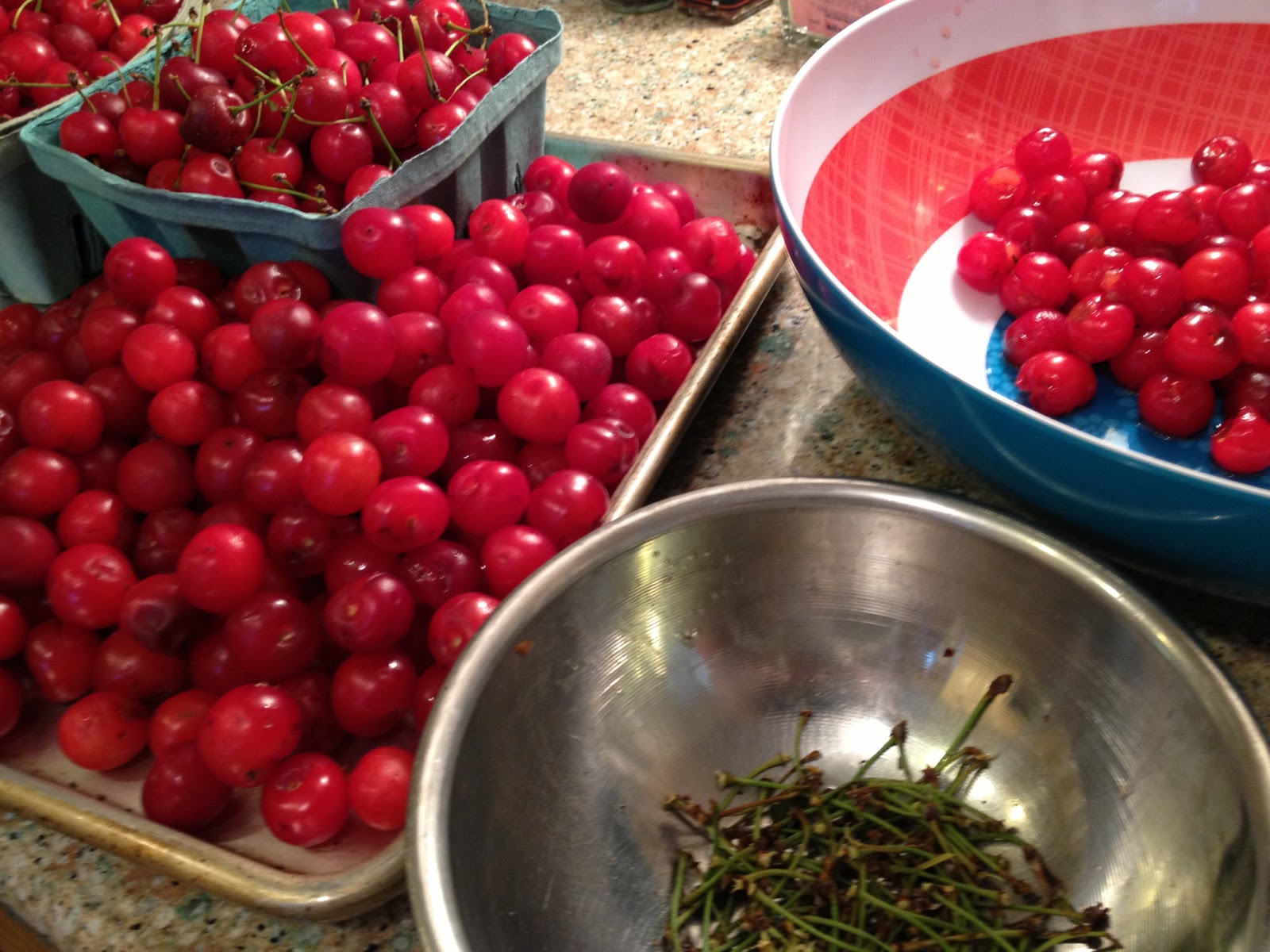
Four quarts of sour pie cherries.  Step one: stem the cherries.


Step two: pit the cherries.


Dang, took me about an hour and a half to stem and pit all the cherries.  The delightful part is that I'm allergic to the raw cherries (not life-threatening, but really annoying sneezing, itchy eyes, etc.).  I have to wear gloves when I handle the fruit.

6 cups stemmed, pitted pie cherries
2 cups sugar
1/2 tsp salt
4 1/2 Tbp Minute® tapioca
1/8 tsp almond extract
2 Pillsbury pie crusts, rolled out and cut into strips
1/4 cup half-and-half
Turbinado sugar

Combine the cherries with sugar, salt, Minute® tapioca, and almond extract, and let sit for about 10 minutes.  Pour into an appropriately sized baking dish.  Cut the pie crusts (I used a ravioli cutter, which gives the edges) into strips, and artfully arrange them over the fruit in the baking dish.

Brush with the milk, and sprinkle with turbinado sugar.


Place on a non-stick foil-lined baking sheet, and bake at 375°F for about 60-65 minutes, or until crust is nicely browned, and the fruit is bubbling up around the edges. 


Cool completely.  Serve with sweetened whipped cream or ice cream.